
Guides
197 guides to Canadian immigration law
Each guide explains how a rule works: where it comes from, the numbers IRCC publishes, and the steps. The rule is the same for everyone. An officer applies it to each file.
- English and French
- Free, no account
- Education, not advice
Type a word to filter every guide on this page
37 guides
Criminal records
How a conviction abroad lines up with IRPA section 36, and the three routes the law sets out: deemed rehabilitation, criminal rehabilitation and the temporary resident permit.
- Can You Enter Canada with a DUI?A guide to DUI and Canadian admissibility. Why DUI became serious criminality in 2018 (Criminal Code s.320.14), CPIC, NCIC and what an officer can ask, TRP vs Criminal Rehabilitation, deemed rehab eligibility for older offences, and the IRCC government fees.
- US Criminal Record & Canada: Complete Master GuideThe starting point for Americans with criminal records. How IRPA s.36 applies, the dual criminality principle, how Canada finds out about a US record (CPIC, NCIC and border questions), serious vs non-serious criminality, all three pathways (deemed rehab, Criminal Rehabilitation, TRP), and links to the specific offence guides.
- Criminal Inadmissibility Canada: Complete Guide to IRPA Section 36IRPA s.36 section by section: serious criminality s.36(1) vs criminality s.36(2), dual criminality principle, hybrid offences, maximum sentence rule, multiple offences rule, and every pathway in the law to overcome inadmissibility (deemed rehab, CR, TRP, record suspension).
- Deemed Rehabilitation Canada: The 10-Year RuleThe 10-year rule under IRPR s.18(2) explained. Which offences can qualify for deemed rehabilitation with no application, how to calculate your timeline from sentence completion, and what disqualifies you (serious criminality, multiple indictable-equivalent convictions).
- TRP vs Criminal Rehabilitation: Which Do You Need?Side-by-side comparison of Temporary Resident Permit (IRPA s.24(1)) and Criminal Rehabilitation (IRPA s.36(3)(c)). Fees (TRP $246.25; rehabilitation $246.25, or $1,231 for serious criminality), timeline differences, a permit that expires vs an approval that removes the ground of inadmissibility, and why neither provision excludes the other.
The other 31 guides in Criminal records
- Assault & Domestic Violence Entry to Canada
- Australian Criminal Record & Entering Canada
- California PC 1203.4 & Canada Entry
- Can I Enter Canada with a Juvenile or Youth Record?
- Can I Enter Canada with Dismissed or Dropped Charges?
- Can I Enter Canada with Multiple Convictions?
- Canada Drug Trafficking Conviction: Can You Enter?
- Canada eTA with a Criminal Record: What You Need to Know
- Canada Medical Inadmissibility: Can a Health Condition Bar Entry?
- Canadian Record Suspension vs US Expungement: How They Affect Canada Entry
- Criminal Harassment & Uttering Threats: Entering Canada
- Criminal Rehabilitation Applications
- Denied Entry to Canada: What to Do Next
- Deported from Canada: Can You Come Back?
- Drug Possession & Canada Entry
- Entering Canada While on Probation or Parole
- Expunged Record & Canada Entry
- Fraud & White-Collar Crime Entry to Canada
- How to Apply for Criminal Rehabilitation in Canada: Step-by-Step
- How to Get a Canadian Criminal Record Check
- Marijuana Conviction & Canada Entry: Can You Cross the Border?
- Pardoned Offence & Canada Entry: Does a Pardon Let You In?
- Pending Criminal Charges: Can You Enter Canada?
- Reckless Driving Conviction Entry to Canada
- Section 44 Report: What It Means & What Happens Next
- Temporary Resident Permits (TRP)
- Theft & Shoplifting Conviction Entry to Canada
- UK Criminal Record & Entering Canada
- US Felony Entry to Canada
- US Misdemeanor Entry to Canada
- Weapons & Firearms Conviction Entry to Canada
Related tool: Start the free explorer
25 guides
Visitors
Visas, eTAs and the rules of a temporary stay: who needs which document, how long a visit lasts, and what the law says when status runs out.
- Do I Need a Visa to Visit Canada? By CountryWhether you need a visitor visa (TRV) or an eTA depends on your nationality and how you arrive. How to determine your status, what US citizens and green-card holders need, and the eTA-X stream.Read the guide
- Canada Visitor Visa (TRV) GuideEverything about visiting Canada: visa-exempt vs visa-required countries, eTA ($7), TRV application process, Super Visa for parents/grandparents (longer stays at a time), proof of ties, invitation letters, and biometrics.Read the guide
- eTA vs Visitor Visa (TRV): Which Do You Need for Canada?Understanding the difference: eTA ($7, linked to passport, valid up to 5 years or until the passport expires) vs TRV (a visa placed in the passport, full application). Visa-exempt vs visa-required countries, dual nationals, transit eTAs, and how to check.Read the guide
The other 22 guides in Visitors
- Biometrics for Canadian Immigration: What You Need to Know
- Can You Work or Study on a Visitor Visa in Canada?
- Canada Digital Nomad & Remote Worker Guide: Can You Work Remotely in Canada?
- Canada Super Visa for Parents and Grandparents 2026
- Canada Super Visa vs Parent Sponsorship 2026: Which Option Is Available?
- Canada Visitor Visa Approval Rates by Country
- Canada Visitor Visa From Nigeria: Requirements
- Canada Visitor Visa Invitation Letter: What to Include
- Canadian Snowbirds: Tax, Health Insurance & Border Rules
- Dual Intent: Visiting While Your PR Is in Process
- How Long Can You Stay in Canada as a Visitor?
- How to Extend Your Visitor Visa in Canada
- Implied Status & Restoration of Status: What Happens When Your Permit Expires
- Overstaying in Canada: Consequences, Restoration & Re-Entry
- Proof of Funds for a Canada Visitor Visa: What Counts?
- Restoring Visitor Status in Canada: The 90-Day Window
- Super Visa vs Parent Sponsorship (PGP): Which Is Right for You?
- US Green Card Holders: Entering & Immigrating to Canada
- Visiting Canada from the UK: eTA & Entry Rules (2026)
- Visiting Canada from the US: What Americans Need to Know
- What to Declare at the Canadian Border: CBSA Rules Explained
- Why Canada Visitor Visas Get Refused: Top Reasons Explained
Related tool: Visa and eTA checker
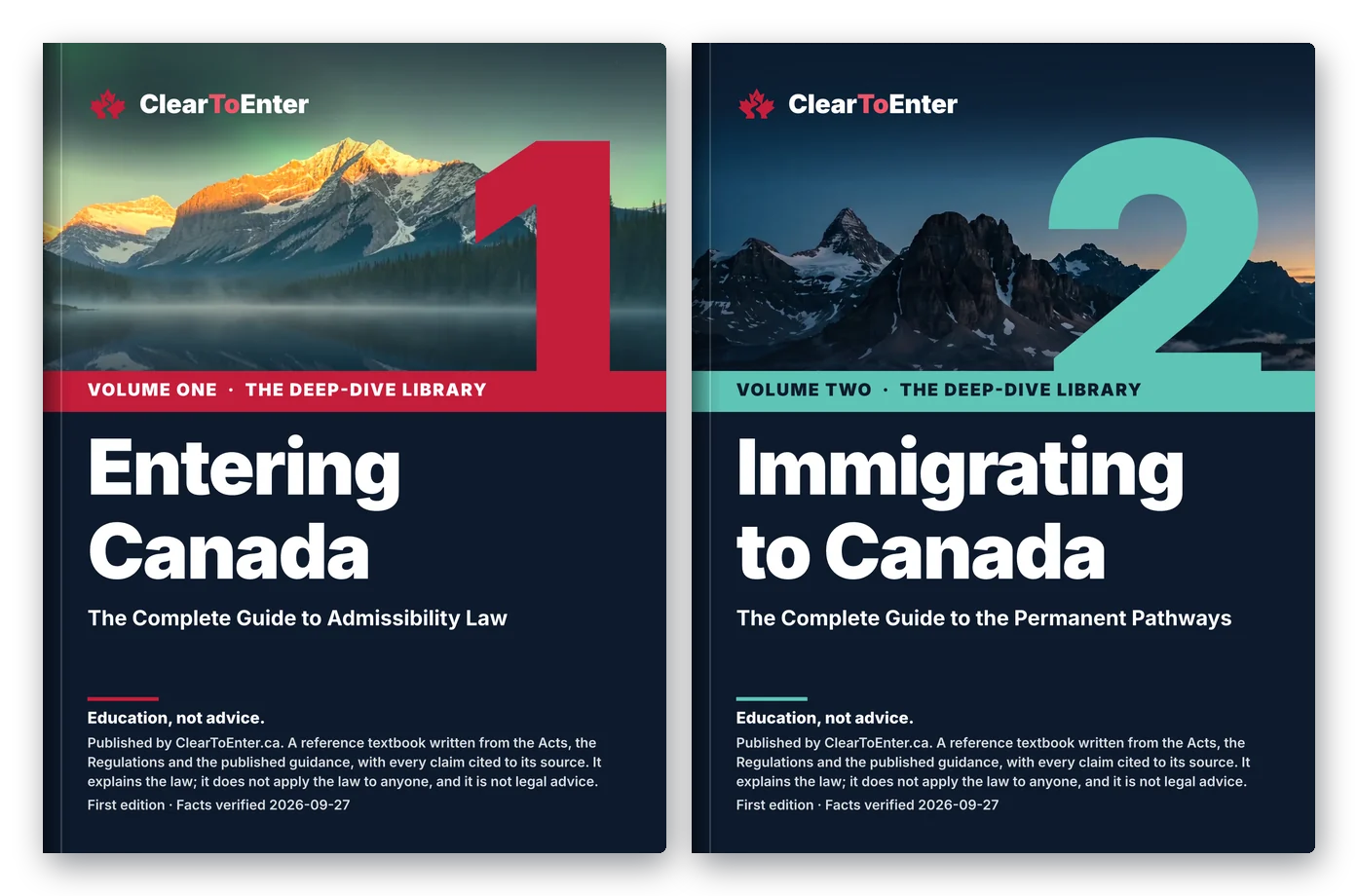
The textbooks
Coming soonTwo textbooks explain Canadian immigration law chapter by chapter, with every rule cited to the law: Entering Canada, on admissibility, and Immigrating to Canada, on the permanent pathways. $79 each, or $129 for both.
47 guides
Immigration pathways
The routes to permanent residence and citizenship: Express Entry, the provincial nominee programs, and the documents that follow landing.
- Canada Permanent Residence: All the Ways to Get PREvery PR route and its 2026 status: Express Entry (FSWP, CEC, FST), PNP, Family Class, Atlantic Immigration, Rural, Quebec, the closed caregiver and Agri-Food pilots, and the paused Start-Up Visa. Comparison table, common requirements, and how to pick a route.Read the guide
- Express Entry: Complete GuideMaster Express Entry: Federal Skilled Worker, Canadian Experience Class, and Federal Skilled Trades eligibility, full CRS scoring table, category-based draws (healthcare, STEM, French), 10 ways to improve your score.Read the guide
- Provincial Nominee Program (PNP) Guide 2026Province-by-province breakdown of PNP streams. How a nomination through an Express Entry-aligned stream adds 600 CRS points, popular streams (Ontario Workforce Priority, BC Skills Immigration, Alberta Accelerated Tech Pathway, Saskatchewan International Skilled Worker), processing times, and eligibility.Read the guide
- How to Become a Canadian Citizen (2026)Full citizenship guide: eligibility requirements, physical presence (1,095 days in the 5 years before you apply), the citizenship test (online, 45 minutes, up to 3 chances), Bill C-3, dual citizenship, and step-by-step application process.Read the guide
The other 43 guides in Immigration pathways
- Americans Moving to Canada
- Atlantic Immigration Program (AIP) Canada 2026: Complete Guide
- BC PNP 2026: Skills Immigration, SIRS & Draws
- Can I Enter Canada with a Mental Health or Psychiatric History?
- Canada Express Entry 2026: Latest Changes
- Canada Foreign Credential Recognition: Getting Your Degree Accepted
- Canada Immigration Processing Times 2026
- Canada PR by Investment: What Exists in 2026
- Canada vs USA Immigration Systems
- Canadian Citizenship Ceremony: What Happens
- Canadian Experience Class (CEC): Eligibility & How It Works
- Citizenship by Descent & Bill C-3 (2026)
- Express Entry Category-Based Draws 2026
- Express Entry vs Provincial Nominee Program
- Federal Skilled Worker Program (FSWP): The 67-Point Grid
- H-1B Visa Holders: How to Move to Canada
- How Much Does It Cost to Move to Canada? Complete Budget Guide
- How to Choose a Province to Immigrate To
- How to Claim Refugee Status in Canada: 2026 Guide
- How to Improve Your CRS Score for Express Entry
- How to Move to Canada from the US (2026)
- Humanitarian & Compassionate Applications: An Exceptional Measure
- IELTS, CELPIP & TEF: Language Tests for Canadian Immigration Explained
- Immigration Lawyer vs RCIC vs Doing It Yourself
- Maintained Status vs Implied Status: What's the Difference?
- Medical Exams for Canadian Immigration: What to Expect
- Move to Canada from China: 2026 Pathways
- Move to Canada From Nigeria in 2026
- Move to Canada From Pakistan in 2026
- Move to Canada From the Philippines in 2026
- Move to Canada from the UAE: 2026 Pathways
- Moving to Canada from India: Complete Immigration Guide 2026
- Ontario PNP (OINP) 2026: Streams and How to Apply
- Permanent Resident vs Canadian Citizen
- Police Certificate Requirements for Canada
- PR Card Renewal: Step-by-Step Guide
- PR Residency Obligation: The 730-Day Rule
- Proof of Funds for Express Entry
- Quebec Immigration: How Quebec's System Differs
- Record of Landing (IMM 1000) & COPR Explained
- Saskatchewan PNP (SINP) 2026: Streams & Points
- The Canadian Citizenship Test
- TR to PR Pathway 2026: Can You Apply?
Related tool: CRS calculator
24 guides
Work and employment
Work permits with and without an LMIA, open work permits, and the occupations that Express Entry selects by category.
- Canada Work Permit Without LMIA: LMIA-Exempt PathwaysThe main LMIA-exempt work permit categories under IRPR R204-R205: CUSMA/USMCA (US/Mexico), Intra-Company Transfers, IEC Working Holiday, Francophone Mobility, other free trade agreements, reciprocal employment, charitable/religious work, post-doctoral fellows, and significant benefit. Includes exemption codes, eligibility, processing times, and why the Global Talent Stream still needs an LMIA.
- Open Work Permit: Who QualifiesAll open work permit categories: spousal OWP, bridging OWP (BOWP), PGWP, refugee claimant OWP, vulnerable worker OWP. Open vs closed permits, eligibility, application process, and processing times.
- LMIA Canada: Workers & Employers GuideComplete Labour Market Impact Assessment guide for both workers and employers. LMIA process, LMIA-exempt categories, Global Talent Stream, high-wage vs low-wage, processing times, and the $1,000 employer fee.
- Canada Working Holiday Visa 2026: IEC: Ages, Countries & How to ApplyComplete IEC Working Holiday guide for 2026: three IEC categories (Working Holiday, Young Professionals, Co-op), eligible countries, age limits (18 to 35, or 18 to 30 for some countries), how the randomized pool and invitation system works, fees (the $184.75 participation fee plus the $100 open work permit holder fee), open permits, duration, and why the permit generally cannot be extended.
The other 19 guides in Work and employment
- Can You Buy an LMIA? The Law on LMIA Fraud
- Canada Caregiver Immigration: Nannies and Home Support Workers
- Canada Immigration for Teachers: Education Category 2025
- Canada Immigration for Tradespeople: Electricians, Plumbers, Carpenters
- Canada PR for Doctors and Physicians: Healthcare Category 2025
- Canada Work Permit for IT & Tech Workers: 2026
- Canada Work Permit with a Criminal Record
- CUSMA / USMCA Work Permit Canada: Guide for Americans and Mexicans
- Engineer Immigration to Canada
- Francophone Mobility Work Permit: The Rules
- Global Talent Stream: 2-Week Work Permits for Tech
- How Nurses Can Immigrate to Canada
- How to Extend Your Work Permit in Canada
- How to Get a Canadian Job Offer From Abroad
- In-Demand Jobs in Canada 2026
- LMIA Process Explained: What Employers Need to Know
- Open Work Permit Eligibility: Who Qualifies in Canada?
- Spousal Open Work Permit: The 2025 Rules
- Why Canada Work Permits Get Refused
Related tool: NOC and TEER finder
847
16 guides
Study
The study permit from the acceptance letter to the post-graduation work permit, with the funds rules and the work limits in between.
- Canada Study Permit GuideEverything you need to study in Canada: DLI requirement, provincial attestation letters (PAL, needed by most new applicants since January 2024), financial requirements ($23,448 for first-year living costs outside Quebec, plus tuition), off-campus work up to 24 hours a week, co-op work permits, and the PGWP as one route to permanent residence.Read the guide
- Post-Graduation Work Permit (PGWP) Guide 2026PGWP eligibility after the November 2024 field-of-study and language changes, PAL requirements, duration rules, DLI requirements, PGWP-to-PR pathways (CEC, PNP), and what to do when your PGWP expires.Read the guide
- Canada Study Permit to PR: The Complete Student PathwayThe full pathway from international student to Canadian PR: DLI selection, PGWP eligibility, Express Entry CEC requirements, how to maximize your CRS score, provincial nominee advantages for graduates, and the timeline step by step.Read the guide
The other 13 guides in Study
- After Graduation: PGWP, CEC, PNP: Your Post-Study Pathways
- Can International Students Work in Canada? Off-Campus Work Rules
- Canada Student Visa for Indian Students: 2026 Guide
- Canada Study Permit Refused: What to Do Next
- GIC for a Canada Study Permit
- How to Choose a DLI in Canada: What Students Need to Know
- How to Study in Canada: Complete Study Permit Guide 2026
- Provincial Attestation Letter (PAL) for a Study Permit
- SDS Is Gone: What Replaced the Student Direct Stream
- Student Budget & Cost of Living in Canada: 2026 Guide
- Study Permit Proof of Funds 2026: How Much Money You Need
- Study Permit Refusal Reasons: How to Avoid a Rejection
- Working While Studying in Canada: Rules & Limits
Related tool: Funds calculator
22 guides
Family
Sponsoring a spouse, partner, child, parent or grandparent: who can sponsor, the income rules, and what the undertaking commits a sponsor to.
- Spousal Sponsorship GuideSponsor your spouse or partner for Canadian permanent residence. Inland vs. outland application comparison, open work permits for partners living in Canada, same-sex partners, dependent children, and IRCC's current processing times.Read the guide
- Canada Family Class Sponsorship: Who Can You Sponsor?Complete guide to all family class categories: spouse/partner (3-year undertaking), dependent children (10 years or until age 25; 3 years if 22 or older), parents/grandparents (20-year undertaking), orphaned relatives, adopted children. Sponsor eligibility rules, income requirements, and what happens when sponsorship breaks down.Read the guide
- Parent & Grandparent Sponsorship (PGP): Complete 2026 GuideComplete guide to Canada's Parent and Grandparent Program (PGP), paused since July 15, 2026: lottery/intake process, LICO+30% income requirements, 20-year undertaking, fees ($1,260 for sponsorship, processing and the RPRF), processing times, and Super Visa as an alternative.Read the guide
- Family Sponsorship Income Requirements (LICO): 2026 GuideCanada family sponsorship LICO+30% income requirements: the latest thresholds IRCC published by family size, what income counts, 3-year tax history requirement, CRA NOA, and why spousal sponsors are generally exempt.Read the guide
The other 18 guides in Family
- Can I Sponsor My Brother to Canada?
- Can You Sponsor a Spouse on a Work or Study Permit?
- Canada Dependent Children Sponsorship: Age Limits and Rules
- Canada Spousal Sponsorship 2026: Timeline, Cost & Process
- Common-Law Sponsorship Canada: Sponsor Without Being Married
- Conjugal Partner Sponsorship Canada: When You Can't Live Together
- Does Marriage Give Canadian Citizenship?
- Immigrating Adopted Children to Canada: Requirements & Process
- Inland vs Outland Spousal Sponsorship: Which Is Better?
- Is There a Fiance Visa for Canada?
- Outland Sponsorship Process: Sponsoring from Outside Canada
- Proof of a Genuine Relationship for Spousal Sponsorship
- Sponsorship Undertaking: How Long You're Responsible
- Spousal Sponsorship Document Checklist for Canada
- Spousal Sponsorship Interview Questions
- Super Visa Income Requirements 2026
- What Happens If Your Sponsorship Breaks Down? Canada Immigration
- Who Can Sponsor a Spouse to Canada? Eligibility
Related tool: Fee calculator
20 guides
Life in Canada
After landing: health care, banking, taxes, housing and the first 30 days.
- Healthcare for Newcomers in Canada: What's Covered & WhenComplete guide to Canadian healthcare for newcomers: provincial health insurance (OHIP, MSP, AHCIP), waiting periods, what's covered, what's not, interim federal health for refugees, and how to apply for your provincial health card.
- Banking & Building Credit in Canada: Newcomer's GuideHow to open a Canadian bank account, build credit history from zero, get a secured credit card, understand the 300 to 900 credit score system, and transfer money to Canada as a newcomer.
- Taxes for New Immigrants: Your First Canadian Tax FilingComplete guide to Canadian taxes for new immigrants: when you become a tax resident, SIN application, filing deadlines, benefits from filing (CCB, Canada Groceries and Essentials Benefit, formerly the GST/HST credit), what income to report, TFSA and RRSP basics.
- Finding Housing in Canada: Rental Guide for NewcomersAverage rents by city (CMHC, 2025), where to search, Canadian leases, tenant rights by province (LTB, RTB), no-credit-history solutions, rental scam red flags, and utilities to ask about.
The other 15 guides in Life in Canada
- A Short History of Canadian Immigration
- Bringing Your Pet to Canada: Import Rules & Requirements
- BSF186 (B4): Personal Effects Accounting Document for Moving to Canada
- Buying a Home in Canada as a Newcomer
- Canadian Phone Plans & Internet: A Newcomer's Guide
- Childcare & Schools in Canada: A Newcomer Parent's Guide
- Cost of Living in Canada by Province: 2026 Comparison
- Driving in Canada: Licence Exchange by Province
- Free Settlement Services in Canada: What the Government Offers
- How to Build a Credit Score in Canada as a Newcomer
- Importing Your Vehicle to Canada: Requirements & Process
- Renting in Canada With No Credit History or Job Letter
- Returning to Canada After Living Abroad: A Returning Resident's Guide
- Understanding Canada: Provinces and Territories
- Winter in Canada: What Nobody Tells You
Related tool: Immigration glossary
13 guides
Policy and updates
What changed and when: the levels plan, fee updates, new pilots and new laws.
- Canada Immigration Levels Plan 2026-2028How the plan holds PR admissions near 380,000 a year while reducing temporary residents, with PR and temporary targets explained.Read the guide
- IRCC Fee Changes 2026: Updated Application & PR FeesThe April 30 PR increases (Express Entry $990, RPRF $600), the March 31 right of citizenship fee increase (adult citizenship now $653), and current study, work, visitor, eTA, PR card and biometrics fees.Read the guide
- Canada Immigration 2026: What's New This Year2026 PR targets (about 380,000), Express Entry category draws, the PGP paused since July 15, 2026, study permit cap and PAL system, work permit changes, IRCC fee updates, and what to watch for in 2026.Read the guide
The other 10 guides in Policy and updates
- Bill C-12: Canada's Immigration Law Explained
- Canada Flagpoling Ban: What Changed in December 2024
- Canada's 10 Biggest Immigration Changes in 2025
- Canada's Temporary Resident Cuts in 2026
- Express Entry Job Offer Points 2026: Back for High-Wage Jobs
- Francophone Community Immigration Pilot (FCIP)
- GCKey & IRCC Portal: How to Track Your Immigration Application
- How to Contact IRCC: Phone, Hours, Web Form
- IRCC Processing Delays Explained: Why Applications Take So Long
- Rural Community Immigration Pilot (RCIP) 2026
Related tool: Processing times
Start from the law itself
The free explorer walks through the grounds of inadmissibility in IRPA one section at a time. It shows the rule and the numbers. An officer decides.