
About ClearToEnter
Making Canadian immigration law readable
ClearToEnter organizes 847 sections of IRPA, IRPR, the Criminal Code, and the Citizenship Act into pages you can search and read, with 197 guides and 17 free tools beside them. It teaches the rules and does not give advice about a case. Officers decide applications and entry at the border.
Last reviewed:
847
sections of IRPA, IRPR, the Criminal Code, the CDSA, the Cannabis Act and the Citizenship Act, with repealed sections left out
197
guides, each in English and in French
17
free tools that work without an account or an email
198
nationalities in the visa and eTA data, last reviewed November 11, 2026
516
NOC 2021 occupation codes in the NOC Finder
What is ClearToEnter?
ClearToEnter is an independent educational resource. It sets out the Canadian law on visiting, working in, studying in and immigrating to Canada, and the figures the government publishes about it.
The law text is taken from the Justice Laws Website. Program figures come from pages published by IRCC, by other federal departments and by the provinces. The full list of sources is on How we verify.
Admissibility decisions are made by officers (IRCC on an application, CBSA at a port of entry) and, in some cases, by the Immigration Division of the Immigration and Refugee Board. For advice about your own situation, consult a licensed immigration lawyer or a registered consultant.
Who is it for?
- Visiting Canada
- The Visa Checker shows the entry document each nationality needs under IRCC’s published lists: a visa, an eTA, or neither.
- A past conviction
- The Admissibility Explorer sets out the inadmissibility sections of IRPA that a set of answers touches. The Rehabilitation Calculator gives the dates the rules produce for the facts entered. An officer decides.
- Working, studying or immigrating
- The CRS Calculator adds up Comprehensive Ranking System points factor by factor. The Express Entry and provincial nominee pages list the rounds that have been published.
- Citizenship
- The Presence Calculator counts days in Canada against the 1,095-day requirement. The practice test draws its questions from Discover Canada, the official study guide.
- Helping someone else
- Family members, employers and settlement workers can use the same pages. The free tools work without an account or an email.
What does the site hold?
The counts come from one generated file that the whole site reads. The number of tools is the one figure set by hand.
| What | Count | Where it comes from | Where to find it |
|---|---|---|---|
| Sections of law | 847 | The Justice Laws Website: 307 from IRPA, 388 from IRPR, 88 from the Criminal Code, the CDSA and the Cannabis Act, and 64 from the Citizenship Act. | IRPA and IRPR Explorer Criminal Code Explorer |
| Guides | 197 | Written for this site from canada.ca and the Justice Laws Website, in English and in French. | All guides |
| Free tools | 17 | Built on the law text and on published figures. | The list below |
| NOC 2021 occupation codes | 516 | Statistics Canada and Employment and Social Development Canada. | NOC Finder |
| Nationalities in the visa and eTA data | 198 | IRCC’s published lists. | Visa Checker |
| IRCC forms | 102 | IRCC’s forms and guides pages. | Forms |
The 17 free tools
- Admissibility Explorer
- Visa Checker
- NOC Finder
- Document Checklist
- Fee Calculator
- IRPA and IRPR Explorer
- Criminal Code Explorer
- CRS Calculator
- Language Converter
- Presence Calculator
- Rehabilitation Calculator
- Processing Times
- Pathway Explorer
- Funds and Income Calculator
- Citizenship by Descent Explorer
- Citizenship Test Practice
- Currency Converter
How does a tool work?
Enter a few facts
Pick a topic or enter a few numbers. The entries only choose which rules the tool shows. You do not need an account.
The tool works in your browser
What you enter is not sent to us. The tool works from the published law and the published figures.
Read the rule and its source
The tool shows the rule, where it is written and what the formula gives with the numbers entered. An officer decides.
Where does the site stop?
The site explains rules. A decision about a person belongs to an officer.
What it is
- An educational resource about publicly available Canadian law
- Law text taken from the Justice Laws Website, with the section number on each entry
- Tools that show a rule, where it is written and what the formula gives
- Published in English and in French
What it is not
- Legal advice of any kind
- An immigration consultancy or law firm
- Affiliated with the Government of Canada, CBSA, or IRCC
- Able to determine admissibility (officers and the Immigration and Refugee Board decide it)
- A substitute for a licensed immigration lawyer or registered consultant
For advice about your own case, go to a Canadian immigration lawyer or a consultant licensed by the College of Immigration and Citizenship Consultants.
What does it cost?
The tools, the guides and the law pages are free to use, without an account or an email. The free tools stay free.
Two textbooks are written and are not on sale today. If the library opens, each volume will be a single purchase with no subscription.
The textbooks
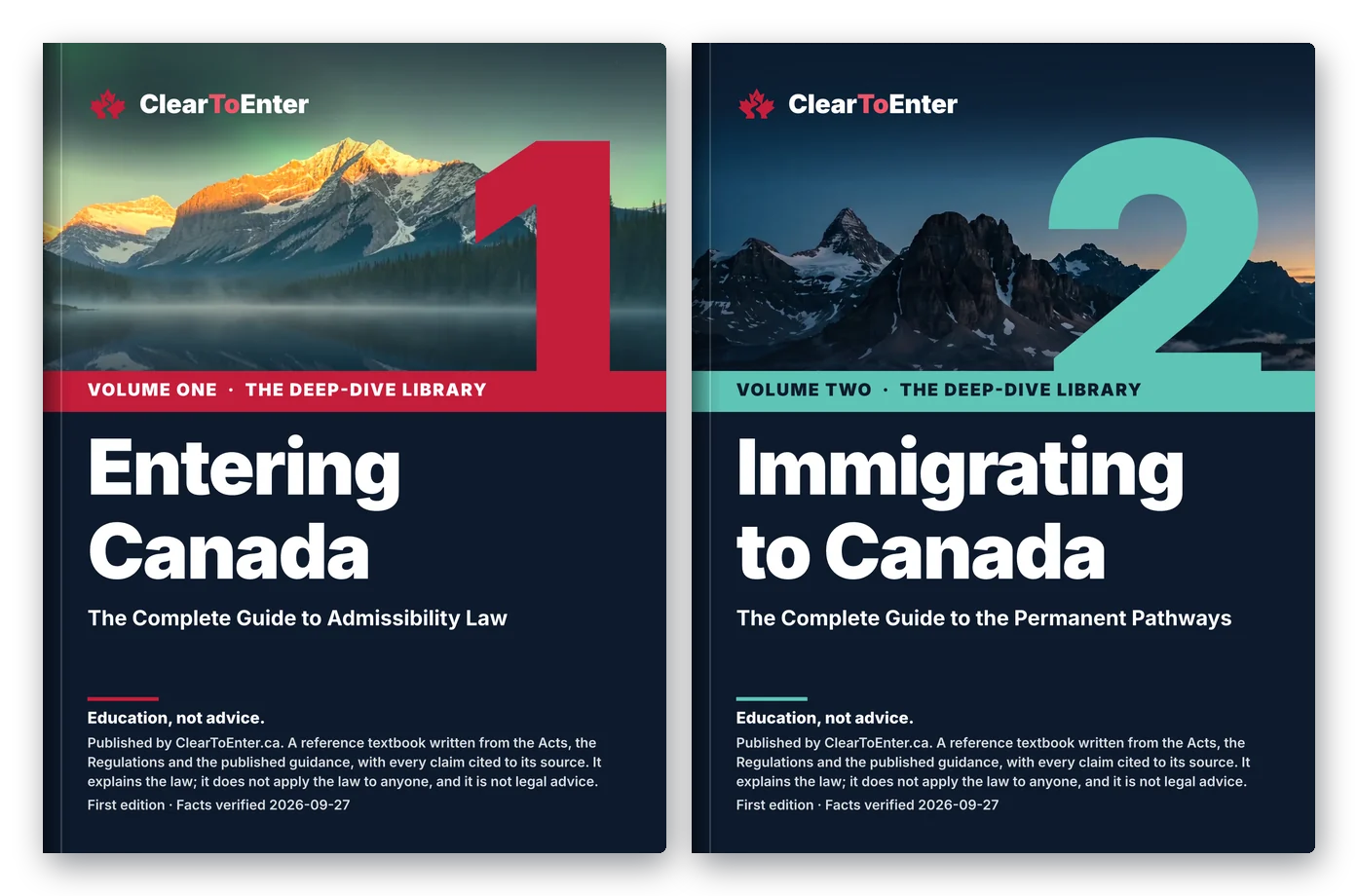
Coming soonTwo textbooks explain Canadian immigration law chapter by chapter, with every rule cited to the law: Entering Canada, on admissibility, and Immigrating to Canada, on the permanent pathways. $79 each, or $129 for both.
How is it kept accurate?
Scheduled checks watch the law and the official pages the site cites. The draw and processing-time data update on a schedule from official pages. A person reads each flagged change before a guide or a chapter is edited.
Built by Canadians

ClearToEnter Team
ClearToEnter was built by Canadians who believe immigration law should be understandable to everyone navigating it. We’re Canadians who built the tools we wished existed when we first tried to understand Canadian immigration law.
Common questions
Is ClearToEnter a law firm or immigration consultancy?
No. ClearToEnter is an educational resource only. We explain publicly available Canadian immigration law (IRPA, IRPR, the Criminal Code, and IRCC policy). We are not lawyers or registered immigration consultants, and nothing on this site is legal advice. For advice specific to your situation, consult a licensed immigration lawyer or a Regulated Canadian Immigration Consultant (RCIC).
Where does your information come from?
The law text comes from the Justice Laws Website. Program figures come from pages published by IRCC, by other federal departments and by the provinces’ own immigration sites. The How we verify page lists each dataset with its source and the date it was last checked.
Do I need to create an account?
No. The free tools work without an account, an email or a login. What you type into a tool is not sent to us. Google Analytics counts anonymous page views, and it does not receive what you type into a tool.
How are the textbooks written?
They are written in advance and are identical for every reader. Each volume explains the law by topic and cites the section of IRPA, IRPR or the Criminal Code behind the rules it explains. The books ask nothing about a reader’s own situation and analyse no individual case. They are not on sale yet.
How to reach a person
Write to report an error or to ask about the site. We cannot give advice about a case.
hello@cleartoenter.ca
Email ClearToEnter