
ClearToEnter

Canadian Immigration Law, Made Understandable

Visitor requirements. Work permits. Criminal admissibility. Financial thresholds. Each one explained, with the section it comes from.

17 free tools, 842 searchable law sections, and a deep-dive library of two textbooks, all cited from IRPA, IRPR, the Criminal Code, and the Citizenship Act.

Start the free explorer

Free • Anonymous • No account needed

An independent educational resource built on official Canadian immigration law. Not affiliated with the Government of Canada.

IRPA s.11, s.12, s.30, s.36

The law, side by side.

Pick a situation. See the section of law that covers it, what it means, and the free tool that goes deeper.

What brings you here?

Immigration and Refugee Protection Act

Criminality

IRPA s.36(2)

The law says

  1. A foreign nationalOur reading: This is anyone who is not a Canadian citizen or a permanent resident.s.2(1)
  2. is inadmissible on grounds of criminality forOur reading: That person is barred from Canada for a crime in the case set out below.
  3. Words left out here
  4. (b)having been convicted outside CanadaOur reading: One of those cases is a conviction for an offence outside Canada.
  5. of an offence that, if committed in Canada,Our reading: The test asks what that offence would be if it had happened in Canada.
  6. would constitute an indictable offence under an Act of ParliamentOur reading: If it would be an indictable offence under a federal law, this rule covers it.
  7. Words left out here

What that means

This rule is called criminality. It applies to foreign nationals, not to permanent residents. It covers a conviction, in Canada or abroad, for an offence that would be indictable here. It also covers two convictions for separate offences. It can cover an act done abroad, even without a conviction. Serious criminality is a separate rule, in s.36(1).

Application before entering Canada

IRPA s.11(1)

The law says

  1. A foreign nationalOur reading: This is anyone who is not a Canadian citizen or a permanent resident.s.2(1)
  2. must, before entering Canada,Our reading: That person has to act before they come to Canada.
  3. apply to an officerOur reading: They must apply to an officer.
  4. for a visa or for any other documentOur reading: They ask for a visa or for another document.
  5. required by the regulations.Our reading: The regulations set out which documents are required.

What that means

This is the basic rule for coming to Canada. Most people need a visa or an electronic travel authorization before they travel. An officer issues it only if satisfied that you meet the requirements and are not inadmissible, meaning barred from entering. People who came as part of a designated irregular arrival must also wait five years before they can apply for permanent residence.

Work and study in Canada

IRPA s.30(1)

The law says

  1. A foreign nationalOur reading: This is anyone who is not a Canadian citizen or a permanent resident.s.2(1)
  2. may not work or study in CanadaOur reading: That person may not work or study in Canada, except as the next line says.
  3. unless authorized to do so under this Act.Our reading: The exception is when this Act gives them permission.

What that means

Nobody from abroad can take a job or enrol in a program here without permission. That is where work permits and study permits come from. An officer can grant the permission if you meet the rules, and can refuse or revoke a work permit for public policy reasons the Minister has published. Those reasons target humiliating or degrading treatment of workers, including sexual exploitation. A refusal on that basis needs a second officer to agree.

Economic immigration

IRPA s.12(2)

The law says

  1. A foreign nationalOur reading: This is anyone who is not a Canadian citizen or a permanent resident.s.2(1)
  2. may be selected as a member of the economic classOur reading: Canada may choose that person as a member of the economic class.
  3. on the basis of their abilityOur reading: The choice rests on what the person is able to do.
  4. to become economically established in Canada.Our reading: What counts is the ability to earn a living and settle in Canada.

What that means

The economic class is for people chosen for their ability to support themselves and settle into work in Canada. Express Entry, the provincial nominee programs and the other economic programs all belong to this class.

Family reunification

IRPA s.12(1)

The law says

  1. A foreign nationalOur reading: This is anyone who is not a Canadian citizen or a permanent resident.s.2(1)
  2. may be selected as a member of the family classOur reading: Canada may choose that person as a member of the family class.
  3. on the basis of their relationshipOur reading: The choice rests on a family tie.
  4. as the spouse, common-law partner, child, parentOur reading: The person is a spouse, a common-law partner, a child or a parent.
  5. or other prescribed family memberOur reading: Or they are another family member named in the regulations.
  6. of a Canadian citizen or permanent resident.Our reading: The tie is to a Canadian citizen or a permanent resident.

What that means

The family class lets a Canadian citizen or permanent resident sponsor close family. That means a spouse or partner, a child, a parent, or another family member the regulations name.

The law stays exactly as written. The lines between are ours, and the section is linked so you can check them.

IRPA · IRPR · Citizenship Act

16 Tools Built on Real Legislation

IRPA, IRPR, Criminal Code, every tool references the actual statutes. Cited, verified, and linked to the official source.

Documents & Details

9 tools

S.C. 2001, c. 27 · SOR/2002-227

Every answer traces back to the source.

The legislation, explained, with a link to the official text beside every rule.

  1. IRPA & IRPR

    690 sections

    Immigration and Refugee Protection Act & Regulations

    Verify on justice.gc.ca(opens in a new tab)
  2. Criminal Code

    88 sections

    Criminal Code of Canada & Controlled Drugs and Substances Act

    Verify on justice.gc.ca(opens in a new tab)
  3. IRCC Policy

    official operational guides

    Operational guides and policy manuals from IRCC

    Verify on canada.ca(opens in a new tab)

No account. No email. Your answers stay with you.

You never sign up or give your name to use the free tools. What you type into a tool stays in your browser and is never sent to us or to analytics. We count page visits anonymously with Google Analytics.

  • No account required
  • No email collected
  • Tool answers stay in your browser
  • Anonymous page counts only
Read the privacy policy
How we source our information

All content is derived from publicly available Canadian legislation published on justice.gc.ca and canada.ca. We do not use proprietary legal databases, client data, or insider knowledge.

Every section, every equivalency, and every guide references specific legislative provisions. You can independently verify every finding by consulting the government sources linked above.

IRPA s.36 · s.12

Two textbooks on Canadian immigration law.

Each volume explains the law chapter by chapter, at a grade 8 reading level, with every rule cited. Education, not advice.

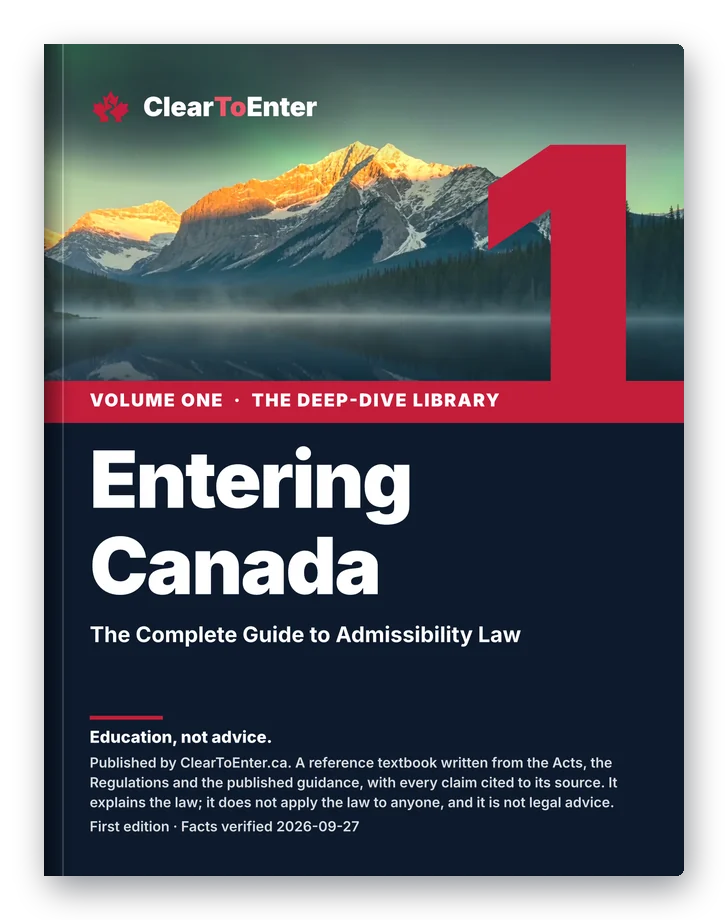
Cover: Volume 1: Entering Canada
Coming soon$79

Entering Canada (Vol. 1)

The admissibility framework explained end to end: IRPA s.36, Criminal Code equivalency, rehabilitation pathways, and TRPs, chapter by chapter, with citations to the public law.

See what's inside: Entering Canada (Vol. 1)
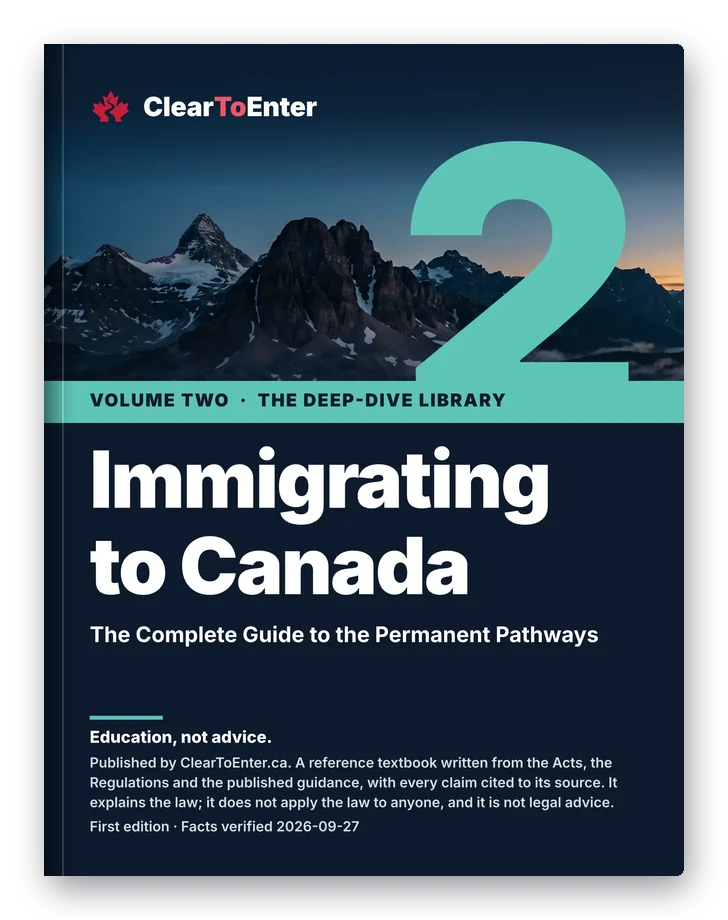
Cover: Volume 2: Immigrating to Canada
Coming soon$79

Immigrating to Canada (Vol. 2)

The permanent residence framework explained end to end: the CRS grid, Express Entry, PNP streams, sponsorship, and published fees and timelines, chapter by chapter, with citations.

See what's inside: Immigrating to Canada (Vol. 2)
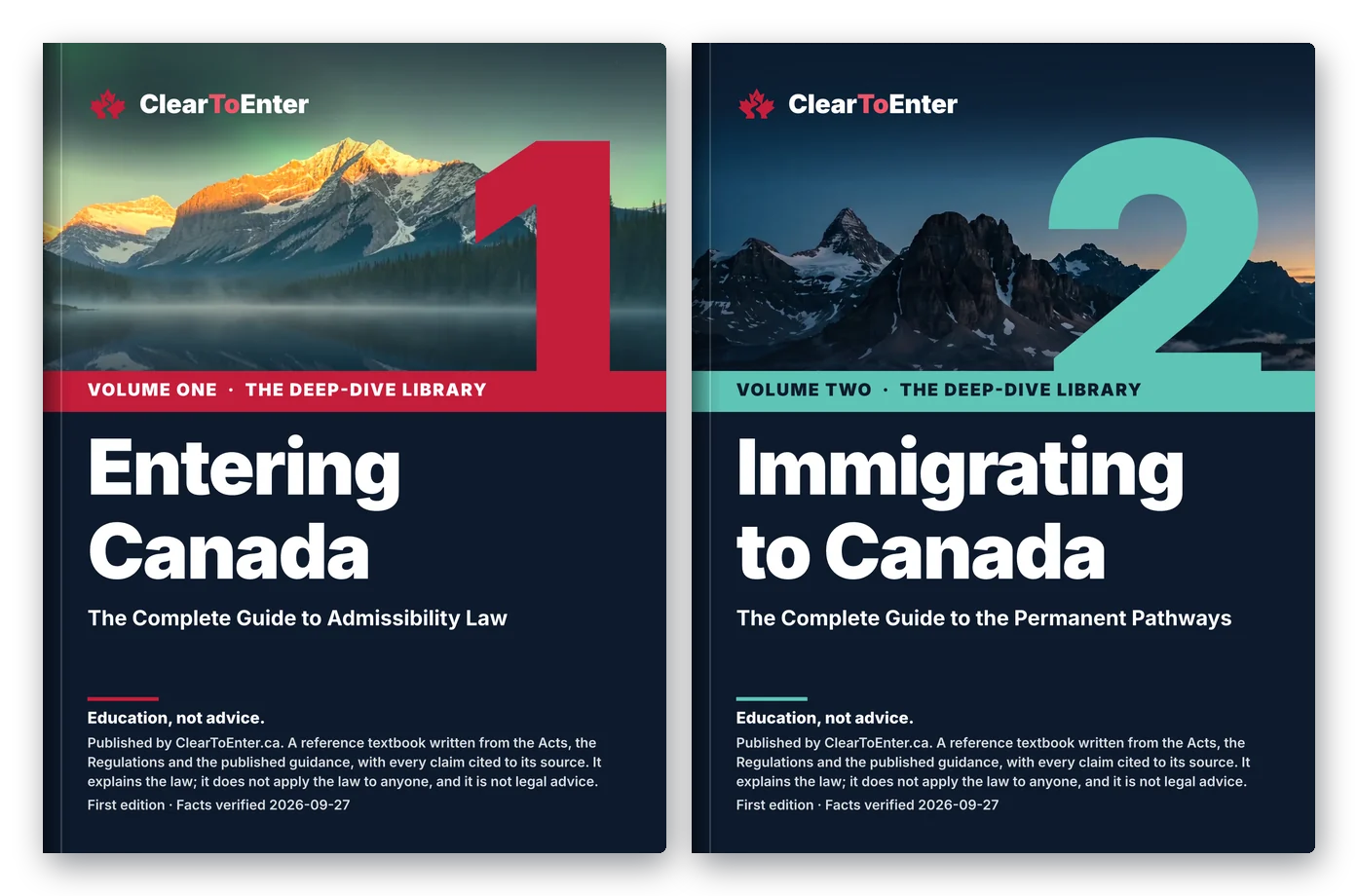
The covers of both volumes: Entering Canada and Immigrating to Canada
Coming soon$129

The Complete Library: both volumes

$79 a volume, or $129 for both. One payment. No subscription. The PDF is yours to keep.

See both volumes and pricing
IRPA s.15 · s.18

Frequently Asked Questions

What ClearToEnter is, where its information comes from, and where its limits are.

Is ClearToEnter a substitute for legal advice?

No. ClearToEnter provides general information based on publicly available Canadian immigration laws (IRPA, IRPR) and official IRCC policies. It is not a substitute for legal advice from a qualified immigration lawyer. Admissibility decisions are made by government officers: CBSA officers at ports of entry, and IRCC officers on applications. For complex cases, especially criminal inadmissibility, refugee claims, or judicial review, consult a lawyer licensed by your provincial law society. IRPA s.15 · s.18

How accurate is this information?

All information is sourced directly from the Immigration and Refugee Protection Act (IRPA), Immigration and Refugee Protection Regulations (IRPR), and official IRCC policy manuals. We reference specific sections (e.g., IRPA s.36 for criminal inadmissibility) so you can verify everything independently. Immigration law changes frequently, always confirm critical details with IRCC before making decisions. IRPA · IRPR

Do I need to hire an immigration consultant?

Whether to hire help is your decision. IRCC designs its processes, including visitor visas, study permits and Express Entry profiles, for individuals to complete themselves. For complex situations, consider consulting a licensed immigration lawyer or a Regulated Canadian Immigration Consultant (RCIC). ClearToEnter explains publicly available immigration law to help you understand the process and requirements. IRPA s.91

Can I enter Canada with a criminal record?

A criminal record does not automatically bar you from Canada, but only a government officer can make that determination: CBSA at a port of entry, or IRCC on an application. Your admissibility depends on the offence, its Canadian equivalent under the Criminal Code, and time elapsed since sentence completion. Options under IRPA include Temporary Resident Permits (immediate), Criminal Rehabilitation (5+ years), and Deemed Rehabilitation (10+ years, non-serious offences only). The Admissibility Explorer sets out the IRPA rules that can apply, section by section. IRPA s.36 · s.24(1)

How much does ClearToEnter cost?

Our Admissibility Explorer, document checklist, and fee calculator are completely free. The Deep-Dive Library volumes, covering the 6 core IRPA inadmissibility grounds, criminal equivalency, and the immigration pathways, start at $79 CAD. See our pricing page for full details. Site policy

What makes ClearToEnter different from other immigration sites?

ClearToEnter is an educational site, and it sells no consultations. It sets out the rules in publicly available Canadian immigration law and cites the section each one comes from, in IRPA, the Regulations or the Criminal Code, so you can read the official text yourself. The guides and tools are free and need no account. For a complex case, it points you to a licensed lawyer. IRPA · IRPR · Criminal Code

Is ClearToEnter affiliated with the Government of Canada or IRCC?

No. ClearToEnter is an independent educational tool. It is not affiliated with, endorsed by, or connected to the Government of Canada, Canada Border Services Agency (CBSA), or Immigration, Refugees and Citizenship Canada (IRCC). Site policy

Still have questions? 🍁 We read every message, hello@cleartoenter.ca

IRPA s.3

Immigration law wasn’t written for everyday people.Understanding it is something anyone can do.

Canada’s immigration law is public. Every section, every regulation and every policy belongs to everyone. ClearToEnter makes it readable and cites the section behind every rule.

Hundreds of thousands of people begin new lives in Canada every year. Yours starts with understanding the rules.

Free • Anonymous • No account needed