How to Study in Canada as an International Student
To study in Canada for more than 6 months, you need an acceptance letter from a designated learning institution (DLI) and a study permit. Most new applicants also need a provincial attestation letter. You must show $23,448 for first-year living costs outside Quebec, plus tuition. After you graduate, a post-graduation work permit can lead to permanent residence.
Last verified: June 2026 · Source: IRCC, IRPA, IRPR
How do I get a study permit in Canada?
A Canadian study permit (governed by IRPA s.11 and IRPR s.211 to s.220) authorizes a foreign national to study at a Designated Learning Institution (DLI). Most programs over 6 months require one. The process has 4 stages:
Get accepted by a DLI
Apply to a Designated Learning Institution. Receive your Letter of Acceptance (LOA), this is required for your study permit application.
Gather documents
LOA, proof of identity (passport), proof of financial support (a single applicant outside Quebec generally must show $23,448 CAD for living expenses for applications made on or after September 1, 2026, plus tuition and travel; confirm the current amount on canada.ca), and any other required documents.
Apply online at IRCC
Submit your study permit application through the IRCC online portal. Pay the $150 CAD government fee (confirm current fee on IRCC). Biometrics may be required.
Receive your study permit
IRCC processes your application (processing times vary; check current times on canada.ca). Upon approval, you generally receive a Port of Entry Letter of Introduction, and your actual study permit is typically issued at the border when you arrive in Canada.
Study Permit vs Visitor: Quick Comparison
| Factor | Study Permit | Visitor (no permit) |
|---|---|---|
| Program length | Any (required if 6+ months) | Up to 6 months only |
| Work rights | On-campus + 24hrs off-campus | Cannot work |
| PGWP eligible | Yes (if DLI + 8+ month program) | No |
| Government fee | $150 CAD | $100 CAD (TRV if required) |
$23,448
Free Study & Immigration Tools
No account required. All tools use official IRCC data.


Canada Study Permit Guides
Detailed walkthroughs based on IRCC policy and IRPA/IRPR regulations.
 Study Permits GuideDLI requirements, eligibility, and IRPR s.211.1 rules
 PGWP CanadaPost-Graduation Work Permit: eligibility, duration, how to apply
 Express EntryPoints-based PR system, the usual route from PGWP work to PR through the Canadian Experience Class
 Move from the USCross-border pathways for Americans and US residents
What is a PGWP and how does it lead to PR?
The Post-Graduation Work Permit (PGWP) under IRPR s.205(c)(ii) is an open work permit issued to graduates of eligible Canadian DLI programs. It's the critical bridge between student and permanent resident for most international graduates.
PGWP Eligibility
Graduate from an 8+ month program at an eligible DLI. Apply within 180 days of receiving your completion letter. No previous PGWP held.

PGWP Duration
Matches your program length. Programs under 2 years: equal to program length. Programs 2+ years: up to 3 years.
Path to PR via CEC
Generally, after at least 1 year of skilled work (TEER 0-3) on your PGWP, you may be eligible to apply for permanent residence through the Express Entry Canadian Experience Class. An officer always decides; confirm current criteria on canada.ca.
Every guide on studying in Canada
Start here
Guides
- How to Study in Canada: Complete Study Permit Guide 2026
- Post-Graduation Work Permit (PGWP) Guide 2026
- Study Permit Proof of Funds 2026: How Much Money You Need
- Canada Student Visa for Indian Students: 2026 Guide
- Provincial Attestation Letter (PAL) for a Study Permit
- Working While Studying in Canada: Rules & Limits
- Can International Students Work in Canada? Off-Campus Work Rules
- Canada Study Permit Refused: What to Do Next
- Study Permit Refusal Reasons: How to Avoid a Rejection
- Canada Study Permit to PR: The Complete Student Pathway
- After Graduation: PGWP, CEC, PNP: Your Post-Study Pathways
- GIC for a Canada Study Permit
- How to Choose a DLI in Canada: What Students Need to Know
- SDS Is Gone: What Replaced the Student Direct Stream
- Student Budget & Cost of Living in Canada: 2026 Guide
- Canada's Temporary Resident Cuts in 2026
Frequently Asked Questions: Studying in Canada
What are the requirements to study in Canada as an international student?
You need a letter of acceptance from a DLI, a study permit for any program longer than 6 months, and, as a new applicant in most cases, a provincial attestation letter. You must show $23,448 for first-year living costs outside Quebec, plus tuition and travel home. You also need a valid passport and usually biometrics. An officer decides each application.
Go deeper: How to get a study permit in Canada
How much does it cost to study in Canada?
The government costs are small next to tuition. The study permit fee is $150, and biometrics usually cost $85. The larger amount is the proof of funds: $23,448 for a single applicant's first-year living costs outside Quebec. Tuition is set by each school and comes on top, along with travel. Quebec sets its own funds figure.
Go deeper: Student budget and cost of living
Do I need a study permit for courses under 6 months?
Generally no. Under IRPR s.188, you can study without a study permit if the course lasts 6 months or less and ends within your authorized stay. A short course brings no work rights and no PGWP. If you might want a post-graduation work permit later, you need a valid study permit at a DLI from the start of your program.
Go deeper: Study in Canada guide
What is a DLI and does my school need to be one?
Yes. A designated learning institution (DLI) is a school a province or territory has approved to host international students. Under IRPR s.211.1, acceptance at a DLI is required for a study permit. Most public universities and colleges are DLIs, and private schools vary. Check your school's DLI status on IRCC's list before you pay a deposit.
Go deeper: How to choose a DLI
Can I work while studying in Canada?
Yes, with a valid study permit at a DLI. You can work on campus with no hour limit (IRPR s.186(f)). Off campus, you can work up to 24 hours a week during academic sessions and full time during scheduled breaks (IRPR s.186(v)), if your permit allows it. You must stay enrolled full time to keep these rights.
Go deeper: Working while studying in Canada
What are the PGWP requirements?
You must finish a program of at least 8 months at an eligible DLI and apply within 180 days of written confirmation that you completed it. For applications made on or after November 1, 2024, you need CLB 7 as a university graduate or CLB 5 as a college graduate. Graduates of most non-degree college programs also need an eligible field of study.
Go deeper: The post-graduation work permit
How long does a PGWP take to process?
IRCC's current estimate for a PGWP applied for inside Canada is 16 weeks. If you apply before your study permit expires, you can generally work full time while you wait, once your program is finished. The fee is $255, the same as any open work permit. The PGWP is one-time, so it cannot be extended or issued twice.
Go deeper: Current IRCC processing times
How do I get PR after studying in Canada?
Most graduates work on a PGWP and then apply through the Canadian Experience Class, which needs 1 year of skilled Canadian work (TEER 0, 1, 2 or 3) in the past 3 years. A Canadian credential of 3 years or more adds 30 CRS points, and a 1 or 2 year credential adds 15. Many provinces also run streams for their graduates.
Go deeper: From study permit to PR
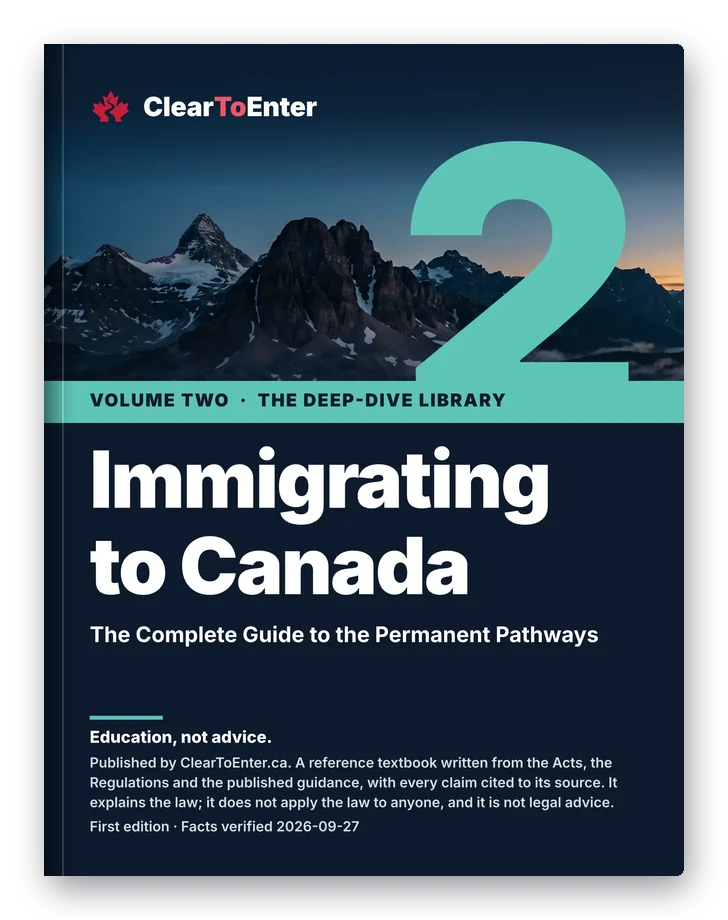
The textbook on this subject
Volume 2: Immigrating to Canada $79
Every major immigration pathway, explained from the published criteria.
Free · No Account · 2 Minutes
Explore the admissibility rules before you apply
Our free admissibility explorer walks you through the IRPA grounds so you can explore the topics that apply.
Start Free Explorer