Maintained Status vs Implied Status in Canada
They are the same protection. Maintained status is IRCC's current name for what people called implied status. Under IRPR s.183(5), if you apply to extend or change your permit before it expires, you keep your status and its conditions until IRCC decides. It ends if the application is refused or you leave Canada.
$246.25
The restoration fee, if status was lost
$155
The work permit fee, added when restoring as a worker
$150
The study permit fee, added when restoring as a student
$85
Biometrics per person if it applies ($170 family maximum)
Confirm current fees on the IRCC website before paying. The Fee Calculator reads the same schedule.
Are maintained status and implied status the same thing?
"Implied status" is the older, informal term. "Maintained status" is the term IRCC now uses on canada.ca, and IRCC generally treats them as the same protection. Nothing changes about your rights because of the label. What matters is whether you applied in time and what your original permit allowed.
The rule comes from IRPR s.183(5). A temporary resident who applied to extend their authorized stay (or to change their conditions) before their authorized period ended continues to have temporary resident status, under the same conditions, until a decision is made on the application.
Your old permit may show an expiry date that has passed. Because you applied in time, you are still a lawful temporary resident, and the conditions of that expired permit (which employer, which school, whether you may work at all) carry over unchanged while you wait.
When does maintained status apply?
Maintained status under IRPR s.183(5) applies when all of these are true:
- You currently hold or held a valid temporary resident status (work permit, study permit, or visitor record).
- You applied to extend or change your status (or conditions) before your permit expired.
- IRCC has not yet made a decision on your application.
If you applied to extend after your permit expired, maintained status does not apply. You lost your status on the expiry date, and your only remaining option may be restoration. The deadline is the expiry date on your permit, not the date IRCC starts processing.
An online application must be submitted before midnight Coordinated Universal Time (UTC) on the day your permit expires. IRCC says to apply at least 30 days before the expiry date.
The rule
If you applied to extend or change your permit before it expired and IRCC has not yet decided, you generally keep your status.
What may you do on maintained status?
While you wait, you may:
- Remain in Canada legally.
- Work for your authorized employer, on the same conditions as the expired work permit.
- Study at your authorized institution, on the same conditions as the expired study permit.
- Keep gaining work experience. Work under maintained status is authorized work, and the Canadian Experience Class counts experience gained while authorized to work under temporary resident status.
- Keep working with an expired SIN until IRCC decides.
You may not:
- Change employers if your work permit is employer-specific, unless IRCC authorizes you to work for the new employer while it processes a new work permit application.
- Change schools or programs beyond what your study permit allows.
- Work if you are on maintained status as a visitor (visitors cannot work).
- Usually, renew a document issued by your province or territory, such as a driver's licence or health card.
What happens if IRCC refuses the extension?
If IRCC refuses your extension application, maintained status ends on the date of the decision. From that point you no longer have authorization to work or study, and you are generally expected to leave Canada. Working after this point is unauthorized work, which has serious consequences for future immigration applications.
The options after a refusal:
- Leave Canada. IRCC's Guide 5551 says a person who has lost status applies for restoration within 90 days or must leave Canada.
- Apply for restoration of status within 90 days of losing status, if you meet the criteria.
- Apply for a different immigration pathway if you qualify (PR, a different permit type).
- Seek judicial review of the refusal if there are legal grounds. For a matter arising in Canada, the application for leave is filed within 15 days after you are notified of the decision or become aware of it (IRPA s.72(2)(b)).
What if you applied after your permit expired?
If your permit expired and you did not apply to extend before the expiry, maintained status never applied. You may still be able to restore your status under IRPR s.182, but only within a specific window and only if you meet the criteria. Restoration is not automatic: an officer reviews the application and decides.
You may generally remain in Canada while IRCC processes a restoration application, but if it is refused you will have to leave.
The restoration requirements:
- IRCC must receive your restoration application within 90 days of losing your status.
- You must still meet the requirements of the status you are restoring to (worker, student, or visitor) and have stopped any activity that needs authorization.
- You must not have failed to comply with other conditions of your stay, for example by working without authorization after your permit expired.
- You generally cannot work or study while the restoration application is pending. Authorization resumes only once restoration and the new permit are approved.
| Restore status as | Fee |
|---|---|
| A visitor | $246.25 |
| A worker | $401.25: the $246.25 restoration fee plus the $155 work permit fee |
| A student | $396.25: the $246.25 restoration fee plus the $150 study permit fee |
Biometrics ($85 per person, $170 family maximum) may also apply.
Which free tool checks your own case?
- Document ChecklistTypical documents by application type
- Processing TimesIRCC wait times by program
- Fee CalculatorCurrent government fees, itemized
Free, with no account. What you enter in a tool stays in your browser.
What do people ask?
What is the difference between maintained status and implied status?
There is no difference in effect. Maintained status is the term IRCC now uses on canada.ca, and implied status is the older, informal name for the same protection under IRPR s.183(5). If you apply to extend or change your permit before it expires, you keep your temporary resident status and its conditions until IRCC decides. The IRPR s.183 page shows the rule itself.
How long is implied status in Canada?
It has no fixed end date. Maintained (implied) status lasts while IRCC processes your extension or change application and ends on the day IRCC decides. If the application is approved, the new permit takes over. If it is refused, the status ends on the date of the decision and you are generally expected to leave Canada. The Work Permit Extension guide covers the timing.
My work permit expired but I applied to extend in time. Can I still work?
Yes. Under IRPR s.183(5), you may keep working for your authorized employer under the same conditions as your expired work permit until IRCC decides on your extension. You cannot switch to a new employer if the permit is employer-specific, unless IRCC authorizes you to work for the new employer while it processes a new work permit application. Keep the dated confirmation of your application with you, because employers may ask for it. The Work Permit Extension guide explains employer changes and bridging permits.
How do I prove I am on maintained status?
Keep a copy of your IRCC application confirmation with your expired permit. The confirmation shows the date you applied, which proves you applied before the permit expired. IRCC says you can show your employer or others proof that you can keep working, and the type of proof depends on whether you applied online or on paper. Employers, schools and border officers may ask to see it. The Document Checklist lists what an extension application needs.
Does implied status apply to visitors extending their stay?
Yes. A visitor who applies for a visitor record before their authorized stay ends keeps visitor status while IRCC decides and may stay in Canada as a visitor. It keeps only a visitor's conditions, so it gives no work or study authorization. The Visitor Extension guide explains how to apply and when to file.
What happens if I leave Canada while on maintained status?
Your maintained status generally ends when you leave. You may be able to return as a visitor if you are otherwise admissible, but you generally cannot resume working or studying on the expired permit until IRCC approves your new one. This applies to any trip, including short trips to the United States, and an officer at the port of entry decides. The Work Permit Extension guide covers travel while you wait.
What is the difference between maintained status and restoration of status?
Maintained status applies when you applied before your permit expired: you keep your status and conditions while you wait. Restoration applies when you applied too late and lost status: under IRPR s.182 you may ask IRCC to restore it within 90 days, but you generally cannot work or study until it is approved, and a restoration fee applies. The Implied Status and Restoration guide walks through both.
Can I apply for PR while on maintained status?
Yes. Maintained status does not stop you from submitting a permanent residence application. Whether you must also keep valid temporary status while the PR file is open depends on the stream, and losing temporary status can affect a bridging open work permit or your ability to keep working. IRCC accepts a bridging open work permit application from a worker whose permit has expired but who has maintained status as a worker. Confirm the rule for your stream with IRCC or a licensed representative. The Canadian Experience Class guide covers one in-Canada route.
Part of:Working in Canada

- Implied Status & Restoration of Status: What Happens When Your Permit Expires
- Canada Flagpoling Ban: What Changed in December 2024
- Canada Digital Nomad & Remote Worker Guide: Can You Work Remotely in Canada?
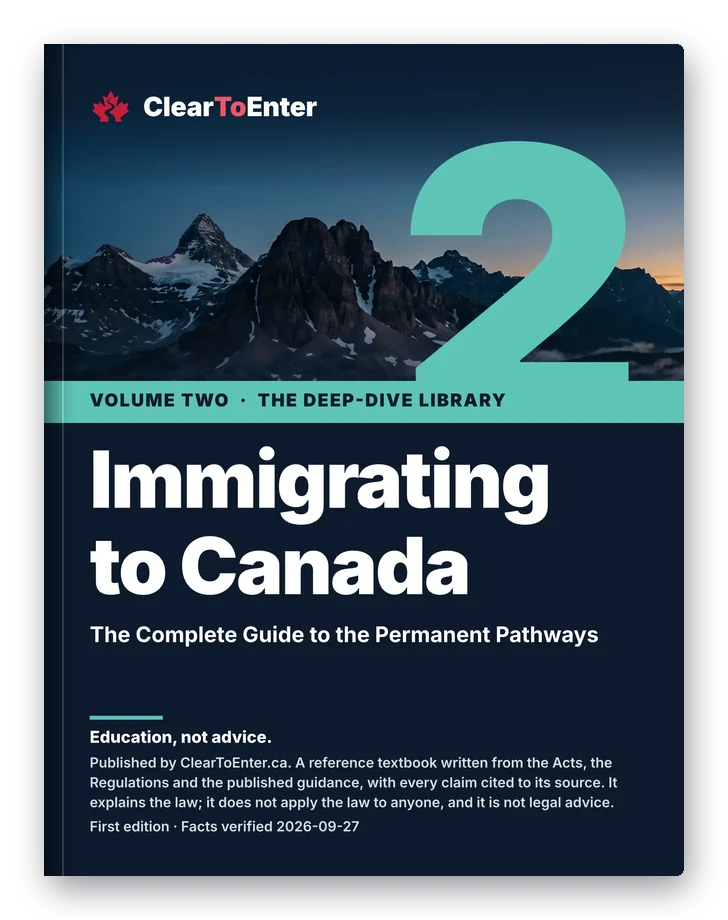
The textbook on this subject
Volume 2: Immigrating to Canada $79
The economic and family pathways to permanent residence, explained from the published criteria.
Follow on Facebook to hear when the library opens (opens in a new tab)Official sources
This page is based on law and policy published by the Government of Canada.