5 steps
Visiting Canada with a record
Five free tools in the order that makes a past conviction and Canadian entry rules easiest to read: travel document first, then the topics in the Act, then equivalency, timelines, and waits.
Learning path
The citizenship grant requirements are among the most precisely published rules in the system: a day count, a residency obligation, a knowledge test drawn from one official study guide, and a numbered set of forms. This path reads them in order. It stores nothing about anyone and decides nothing. IRCC decides applications.
0 of 4 steps marked
Ticking a step stores one flag in this browser, and nothing is sent anywhere.
The Citizenship Act requires 1,095 days of physical presence in Canada within the five years before the day an application is signed, and time spent in Canada before permanent residence can count at half credit up to a published cap. The calculator does the math on those published rules in the browser and keeps the trip list on the device. Officers verify the count against travel history.
IRCC publishes a processing time for citizenship grant applications alongside its other lines of business, and updates it periodically. The tracker shows what is published today. A published time describes how long recent applications took rather than promising a date for a new one.
Applicants within the published age range sit a knowledge test on rights, responsibilities, history, geography and government, drawn from the official study guide Discover Canada. The practice questions here follow that same published material. Practice results are practice only and are stored on the device.
The citizenship grant application has its own numbered forms and instruction guides, published by IRCC and re-issued from time to time. The forms library lists them with the official download page for each. The version currently posted on canada.ca is the one that counts.
These tools orient: they show which published rule applies to a subject and where the official text lives. They do not explain the law in depth, and they never apply it to a person.
The chapters on this subject
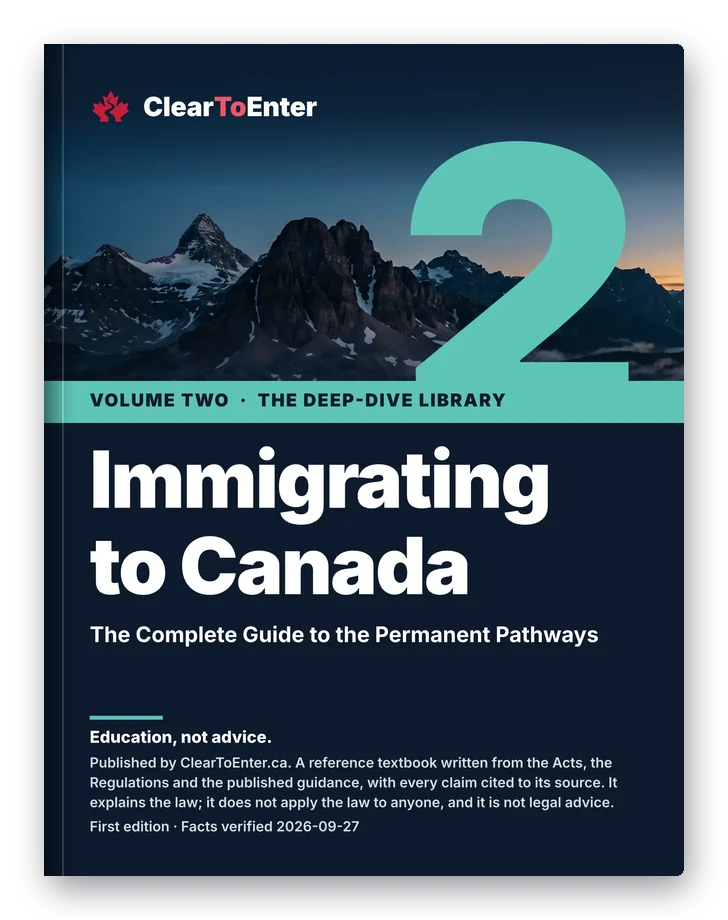
The textbook on this subject
The economic and family pathways to permanent residence, explained from the published criteria.
Follow on Facebook to hear when the library opens (opens in a new tab)5 steps
Five free tools in the order that makes a past conviction and Canadian entry rules easiest to read: travel document first, then the topics in the Act, then equivalency, timelines, and waits.
7 steps
Seven steps through the free tools, in the order the published system is built in: the pathway families first, then the vocabulary they use, then the grids, the draw record, and the money and paperwork.