
Learning path

Immigrating to Canada from zero

Canada publishes its economic immigration system in pieces: program criteria, an occupation classification, a language scale, a points grid, draw results, funds tables and fees. This path reads them in the order they build on each other. It collects nothing, evaluates nobody, and every step links to the tool or the official page.

All learning paths

Progress

0 of 7 steps marked

Progress saved on this device only. Ticking a step stores one flag in this browser. Nothing is sent anywhere, no account exists, and clearing your browser data clears it.

  1. Step 1 of 7

    Browse the pathway families

    Dozens of programs exist, and they group into a small number of families: federal economic, provincial nominee, Quebec, family sponsorship, study and work routes, business and pilots. The pathway explorer lists the published criteria for each family and links to the official page behind it. Reading this first gives the later numbers something to attach to.

    Progress saved on this device only
  2. Step 2 of 7

    Find the occupation code

    Most economic programs describe work through the National Occupational Classification, a five-digit code with a TEER level attached to it. The finder searches the published NOC list by job title and shows the duties that sit under each code. That code is the vocabulary the rest of the system uses.

    Progress saved on this device only

  3. Step 3 of 7

    Understand the CLB scale

    Language ability is expressed in Canadian Language Benchmarks, and each approved test has its own published conversion chart into that scale. The converter shows the published mapping between test results and CLB levels in both official languages. It is a lookup of published tables, nothing more.

    Progress saved on this device only

  4. Step 4 of 7

    Run the published scoring grid

    Express Entry ranks the people already in its pool with the Comprehensive Ranking System, a points grid IRCC publishes in full, factor by factor. The calculator runs that published grid arithmetic in the browser. A score is a position in a pool at a moment in time, not an outcome and not a decision.

    Progress saved on this device only

  5. Step 5 of 7

    See what cut-offs are being published

    IRCC publishes every round of invitations with its date, category, size and cut-off score. The tracker collects those published rounds so the pattern across a year is visible in one place. Past cut-offs describe rounds that already happened; they are not a forecast of the next one.

    Progress saved on this device only

  6. Step 6 of 7

    Read the settlement funds table

    Several programs require proof of settlement funds, and the amounts are published as a table by family size and updated periodically. The calculator reads the table currently published. Published exemptions exist, for example where a person is already authorized to work in Canada with a valid job offer.

    Progress saved on this device only

  7. Step 7 of 7

    Budget and paperwork

    Government fees are published in a single fee list that is indexed periodically, and each application type has a published document checklist and guide. These two tools read those published lists so the cost and the paperwork are visible before anything is started. Third-party costs such as language tests and credential evaluations are published separately by the organizations that charge them.

    Progress saved on this device only

Where this path ends

These tools orient: they show which published rule applies to a subject and where the official text lives. They do not explain the law in depth, and they never apply it to a person. Those are two different places, and both are here.

Need advice about your specific case?

This volume explains the law; it cannot and does not apply it to you. That is the role of a licensed professional.

Go deeper

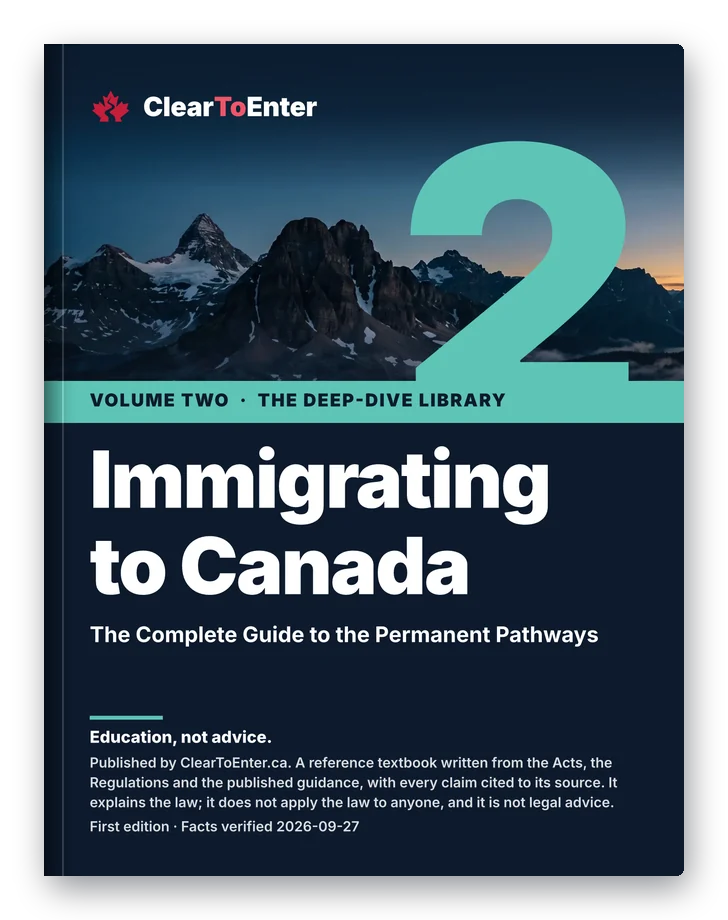
Volume 2: Immigrating to Canada $49.99

The permanent residence system explained in depth: how the Express Entry programs are written, how the ranking grid is built, how provincial nomination interacts with the federal pool, family sponsorship, and the published policy behind each, with the official text cited throughout.

Free tools orient. The Deep-Dive Library explains the law in depth for every reader alike. A licensed professional is the only place that can speak to one person and their situation.