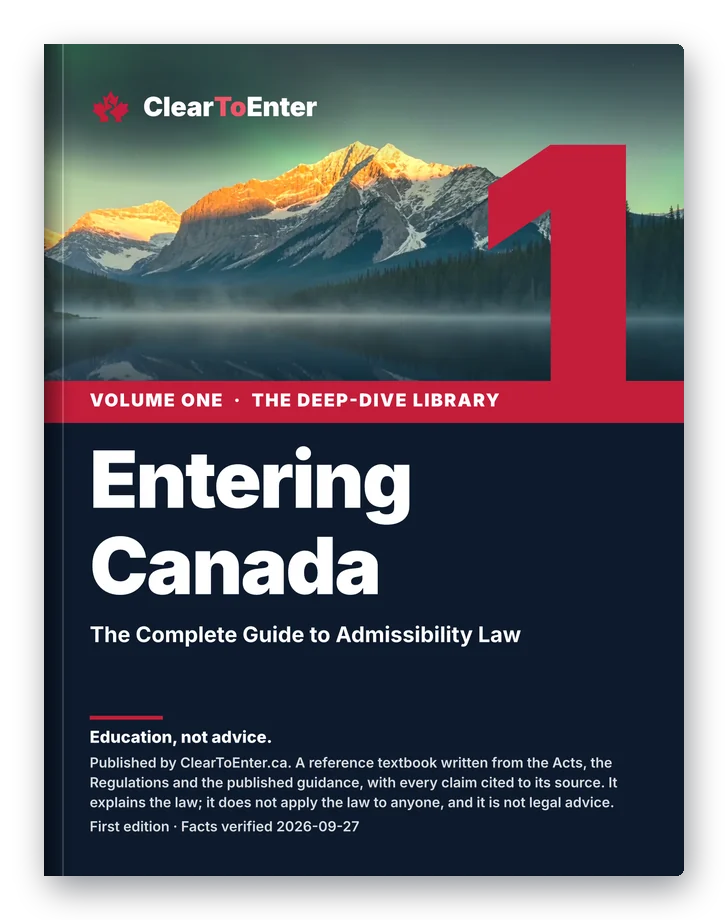
Volume oneThe Deep-Dive Library
Entering Canada The Complete Guide to Admissibility Law
Six IRPA inadmissibility grounds (s.36 and s.38 to s.42) that can keep a visitor, worker, student or permanent resident out of Canada, and the published routes back: equivalency, rehabilitation, record suspensions, temporary resident permits.
No account and no email. It is the same chapter the paid edition opens with.
Downloading the PDF makes this purchase final. Until then, the 14-day refund is yours.
- 9 h 26 min across 12 chapters
- Facts verified 2026-11-06
- English and French
- 12 chapters
- 22 worked examples
- 19 tables
- 67 misconceptions answered
- 140 links to the official sources
Real pages from chapter 1
Each sheet below comes straight from the free chapter. The other 11 chapters are built the same way.
The short answers first
Every chapter opens with the questions it settles. Each answer is one line with its source.
In all 12 chapters
Chapter 1 · How Admissibility Works: The IRPA Framework
The short answers
- What does inadmissible mean?
- It is the Act's word for a person who may not enter or remain in Canada.IRPA Division 4, s.33 to s.43
- How many reasons are there?
- Eleven. The same part of the Act also holds three procedural sections, which say how to read the list and how relief works.IRPA s.34 to s.42
- Who decides?
- An officer decides, before travel or at the border. A case referred inland goes to the Immigration Division.IRPA s.11(1), s.18(1), s.45
- How much proof does it take?
- Five grounds use a lower test, reasonable grounds to believe. The other six use the ordinary civil test, more likely than not.IRPA s.33; IRCC enforcement manual ENF 5 (2025-02-20), Table 4
+ 2 more answers on this page of the chapter
Myths corrected
What people commonly believe, followed by what the law says.
67 in this volume
Chapter 1 · How Admissibility Works: The IRPA Framework
Common belief
A visa means I have already been found admissible.
What the law actually says
A visa is permission to travel and be examined, so the decision is made again at the border. Section 18(1) requires every person seeking to enter Canada to appear for an examination. Section 20(1) requires a foreign national who seeks to enter or remain to establish that they meet the requirements. IRCC's own manual says a visa "is no more than a stamp on a piece of paper issued outside Canada which may give the holder a colour of right to come into Canada, but no more. Immigration status is acquired at the port-of-entry" (ENF 1, Appendix A). So status is granted at the counter, or not at all.
The rule in one line
Key rules also stand alone with their citation, short enough to screenshot.
47 in this volume
Chapter 1 · How Admissibility Works: The IRPA Framework
The rule in brief
Every person seeking to enter Canada must appear for an examination. Each arrival is its own examination, so a crossing that went smoothly last year settles nothing about the next one.
IRPA s.18(1)
Lookup tables
Anything a reader would look up is set as a table.
19 in this volume
Chapter 1 · How Admissibility Works: The IRPA Framework
Division 4: every ground, who it reaches, and the standard of proof
Division 4: every ground, who it reaches, and the standard of proof Ground Section Standard of proof Security s.34 Reasonable grounds to believe (s.33) Human or international rights violations s.35 Reasonable grounds to believe (s.33) Sanctions s.35.1 Reasonable grounds to believe (s.33); ends when the sanction ends (s.35.1(2)) Serious criminality and criminality s.36 Reasonable grounds to believe (s.33), except a permanent resident under s.36(1)(c), which is balance of probabilities (s.36(3)(d)) Organized criminality s.37 Reasonable grounds to believe (s.33) Health grounds s.38 Balance of probabilities Financial reasons s.39 Balance of probabilities Misrepresentation s.40 Balance of probabilities Cessation of refugee protection s.40.1 Balance of probabilities Non-compliance with the Act s.41 Balance of probabilities Inadmissible family member s.42 Balance of probabilities 3 of 5 columns shown here. The chapter prints all 5.
Check yourself
A few questions close each chapter. Try this one. Nothing is scored, stored or sent.
37 questions in this volume
Chapter 1 · How Admissibility Works: The IRPA Framework
Check yourself
All 12 chapters
Real titles and honest reading times. Chapter 1 is free to read in full.
- How Admissibility Works: The IRPA FrameworkFree
- Criminal Inadmissibility: s.36(1) and s.36(2)In the full volume
- The Equivalency Framework: How a Foreign Offence Becomes a Canadian OneIn the full volume
- The Relief Map: Deemed Rehabilitation, Criminal Rehabilitation, Record Suspensions, TRPs and ARCsIn the full volume
- Misrepresentation: IRPA s.40In the full volume
- Non-compliance with the Act: IRPA s.41In the full volume
- Inadmissible family member: IRPA s.42In the full volume
- Medical Inadmissibility: What Section 38 Actually AsksIn the full volume
- Financial Inadmissibility: Section 39In the full volume
- Why Sections 34, 35 and 37 Are Not Covered HereIn the full volume
- At the Border: What an Examination Is, and What the Published Manuals Say HappensIn the full volume
- One Crossing, Start to FinishIn the full volume
Not in this volume
- The security, human-rights and organized-crime grounds (s.34, s.35, s.37): these need a licensed professional, not a book.
- Immigration programs and Express Entry: that is Volume 2.
Every rule carries its source
Each rule is quoted from the official text and linked to it. Each chapter carries the date its facts were last checked.
Every chapter was checked against the law in force on this date.
- links to the official sources
- 140
- worked examples, each one hypothetical
- 22
- checklist items, each with its citation
- 92
How this book stays current
Immigration law changes during the year. Scheduled checks watch the official sources behind every chapter, and a person revises the chapter when one of them changes.
The official sources
- Justice Laws
- The Acts and the Regulations. The books rest on the Immigration and Refugee Protection Act and its Regulations, the Criminal Code and the Citizenship Act.
- The Canada Gazette
- New regulations, read in Part II as they are published.
- canada.ca
- IRCC’s instructions, program criteria and published figures.
Where a rule is published on another official page, the chapter cites that page and the weekly watch reads it too.
The watch
Every day
The published books
The site’s own checks run again on the published version. One of them fails if an English chapter has changed and its French has not.
Every week
The law
Justice Laws is read for the date each Act and Regulation was last amended. The Canada Gazette is read for new immigration regulations.
Every week
The cited pages
Every official page a chapter cites is opened. A page that has moved, gone or changed since the chapter was checked goes on a list.
Every year on November 6
The edition
A checklist opens for the yearly edition. It asks for one full pass over both books, a dated entry in each volume’s list of changes, and rebuilt PDF copies.
When a source changes
Flagged
The watch writes a report and stops there. No scheduled job can edit a chapter.
Revised by a person
A person reads the change at the official source and revises the chapter, in English and in French. A chapter is never changed automatically.
Dated
The chapter’s date moves to the day it was checked again.
Where you see it
Facts verified 2026-11-06
- On each chapter
- A stamp with the date its facts were last checked.
- On the PDF copy
- The edition date, printed on the cover.
Latest change ·
Updated for changes in force in November 2026: penalties for unauthorized or misrepresenting paid representatives (SOR/2026-220 and SOR/2026-221) in the misrepresentation chapter, and the end of a refugee claimant's examination (SOR/2026-218) in the border chapter.
A date says when a chapter was last checked. The law can change the day after, so confirm a rule at its official source before you act on it.
Read how we verifyVolume 1: Entering Canada
$79Buy once. Every future edition is included.
Downloading the PDF makes this purchase final. Until then, the 14-day refund is yours.
What a purchase includes
Read it here, on any device. Download a PDF copy when you want one.
- The textbook
- The website edition is the textbook. Each chapter shows the date it was last checked.
- Future editions
- Buy once. Every future edition is included.
- The PDF copy
- Download a PDF of each volume you own, in English or French, when you want one. Your copy carries your email and receipt number in its footer.
- The refund
- The 14-day refund covers the website edition until the first PDF download. A refund ends access.
- Your details
- No account, and the site collects no email. Stripe handles the payment.
Buying opens after a final review. Chapter 1 is open now.
Both volumes together are $129. See the complete library

Education, not advice.
Published by ClearToEnter.ca. A reference textbook written from the Acts, the Regulations and the published guidance, with every claim cited to its source. It explains the law; it does not apply the law to anyone, and it is not legal advice.
Where a specific case begins
This volume explains the law. Applying it to one person’s facts is regulated work for a licensed professional. Both public directories are below.